














When Africa’s economic rise is finally documented, November 10, 2025, will likely be remembered as one of those quiet turning points, when ambition aligned with structure and the conversation shifted from possibilities to action.
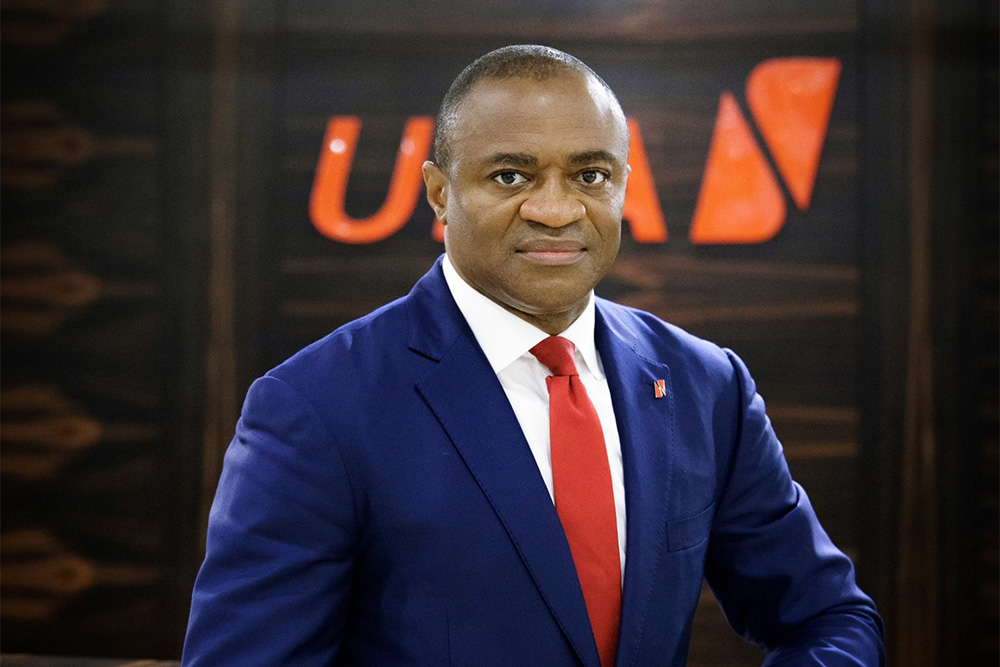
At the UAE–Chad Trade and Investment Forum in Abu Dhabi, UBA’s Group Managing Director/CEO, Oliver Alawuba, delivered a keynote that felt less like a speech and more like a direction of travel for the continent. Under the theme “Financing African Competitiveness: Building Bridges, Powering Progress,” he laid out a bold, practical roadmap for the future of African finance.
“The era of potential is over. We are now in the era of execution,” he said, drawing a line between a continent that once waited for validation and one now ready to define its own course.
At the centre of his remarks was Tchad Connexion 2030, Chad’s $30 billion national development plan spanning 268 projects in energy, infrastructure, water systems, and human development. Alawuba framed it not just as a project pipeline but as a statement of intent; a shift from the margins of global economics to its main stage.
But what set his address apart was his argument for a new financial architecture for Africa, one built on local capital, regional expertise, and global partnerships that rest on credibility, not sentiment. His proposed model brings together international capital, African institutional banks, and Development Finance Institutions, forming a structure that works both financially and strategically.
He reminded the audience that African banks are now “architects of finance,” backing that claim with real numbers:
- $400 million for Tanzania’s Julius Nyerere Hydropower Project
- $700 million toward strengthening Nigeria’s power sector
- $315 million into Ghana’s road networks
The message was unmistakable: African banks are already financing Africa’s transformation at scale.
In Chad, UBA’s footprint is deep and deliberate; over $102 million in government securities, $49 million into a domestic gas project, $6.7 million for a wind farm in Amdjarass, and major investments across energy and telecoms. “We are here to be the bridge between vision and reality,” Alawuba said.
Yet, it wasn’t only the big-ticket projects that defined his message. Alawuba’s insistence on inclusion resonated strongly. He argued that Africa’s competitiveness cannot be real if it doesn’t reach Beira, Nzerekore, Gulu, beyond the familiar hubs of Lagos and Nairobi. With UBA expanding deeper into underserved regions, he stressed that smallholder farmers and micro-entrepreneurs are as central to Africa’s rise as multinationals.
Perhaps the most defining moment was his challenge to the old belief that Africa lacks capital. Drawing from Africa Finance Corporation data, he noted that Africa holds about $4 trillion in domestic financial assets, yet less than 15% is funnelled into productive infrastructure.
“Our challenge has never been capital,” he said. “It has always been the absence of bankable structures and credible partnerships.”
In that instant, the narrative shifted. Africa wasn’t waiting to be rescued; it was waiting to be properly structured.
Alawuba also invoked the wisdom of Sheikh Zayed bin Sultan Al Nahyan: “Our forefathers lived and survived in a difficult environment because they recognised the need to work together.” It was a call to unity, resilience, and collective progress—echoing the spirit behind the UAE–Chad partnership.
That partnership itself stands as a symbol of modern South–South collaboration, practical, investment-driven, and anchored in mutual prosperity. For Chad, it represents a decisive move toward long-term transformation. For Africa, it showcases what becomes possible when vision meets viable financing.
Alawuba’s message was ultimately a manifesto for African confidence, one built on competence, collaboration, and capital. He reminded the world that Africa’s future won’t be written in aid documents but in balance sheets, construction sites, and the infrastructure that connects communities.
If Tchad Connexion 2030 is the blueprint, and leaders like Alawuba are the builders, then Africa’s next chapter is not only promising, it is already under construction.
This piece is adapted from an article written by Bamidele Johnson. You can read the original version here.